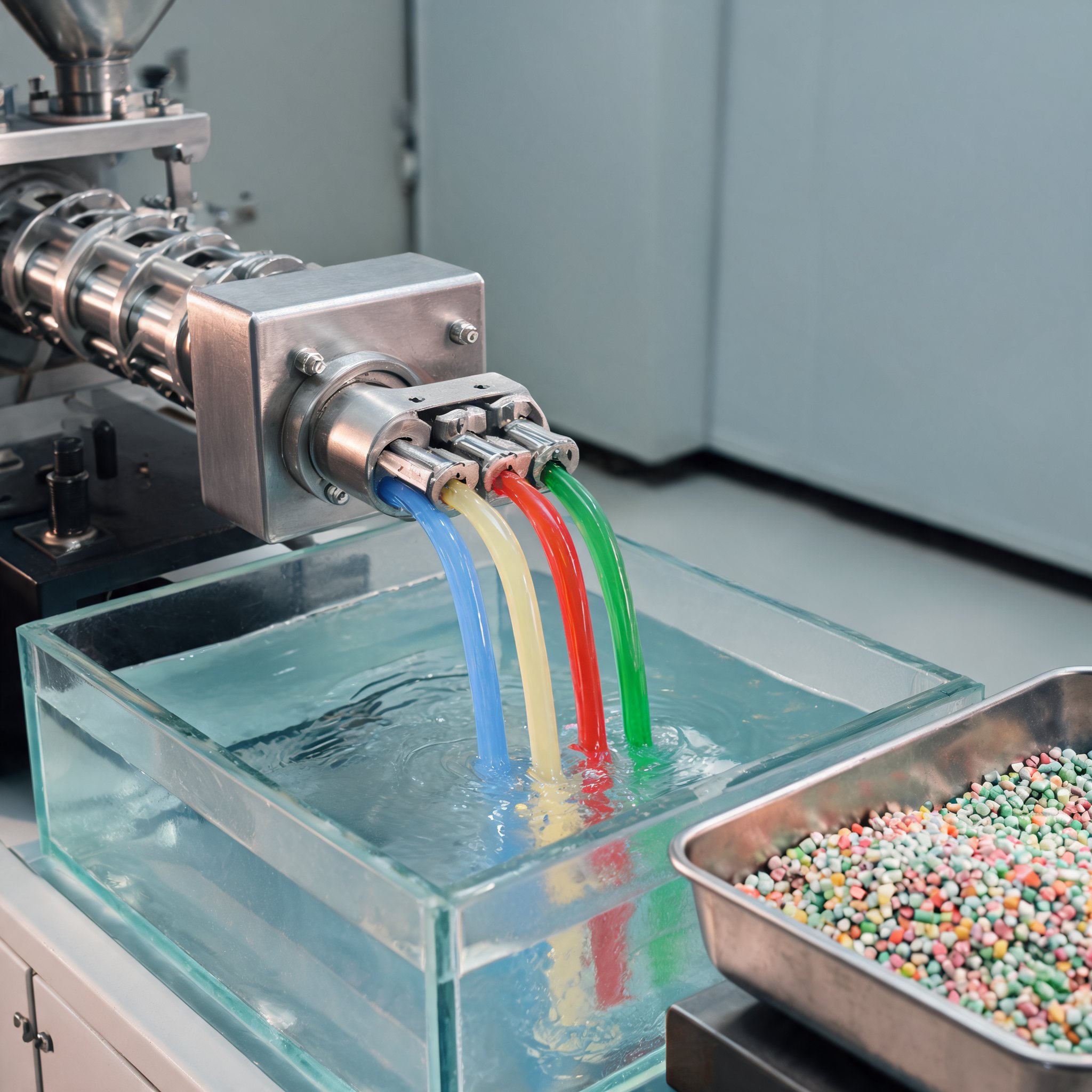
Colour is one of the last areas where plastics still lean heavily on conventional pigment chemistry, and that creates friction with biodegradability goals. A study published in Sustainability examined whether natural colorants can be turned into colour masterbatches and run on standard equipment without sacrificing colour, flow behaviour or mechanical performance. The researchers worked with four commercial natural pigments — blue spirulina, yellow curcumin, red beetroot and green chlorophyllin — and compounded them into polylactic acid (PLA) and polybutylene succinate (PBS).
The masterbatches were produced by twin-screw extrusion and then let down into the matching polymer at 2, 4 and 6 wt%, with test specimens made by injection moulding. The formulation also contained titanium dioxide, calcium carbonate and stearic acid, described in the study as supporting ultraviolet protection, pigment dispersion and processing. The extruder ran at 65 rpm with a feed rate of 2 kg/h, and the temperature profiles were chosen so that each polymer would melt while limiting heat exposure to the pigments: 145 °C for PBS and 190 °C for PLA.
Degradation onset leaves a narrow window
Thermogravimetric analysis placed the degradation onset of the four colorants at roughly 229 °C for spirulina, 244 °C for curcumin, 258 °C for chlorophyllin and 267 °C for beetroot. Both matrices degrade at considerably higher temperatures, but the margin between pigment stability and polymer melting is thin enough that the processing window has to be managed deliberately. Rather than pushing temperatures for easier flow, the team selected profiles that melted the polymer with the least possible thermal load on the colorant.
Why spirulina worked in PBS but not in PLA
Most pigment–polymer pairs came through that window intact, but spirulina did not. During PLA processing the pigment lost its characteristic blue, and a blue PLA masterbatch could not be produced. In PBS, whose 145 °C profile is markedly cooler than PLA's 190 °C, the same pigment retained enough stability to compound successfully. The contrast is instructive: spirulina's measured onset temperature sits above the PLA processing temperature, which indicates that a thermogravimetric onset value on its own is not a sufficient predictor of whether a natural colorant will survive a given melt process. The authors draw a narrower, firmer conclusion from the result — compatibility depends strongly on the thermal requirements of the matrix.
Melt flow and mechanical baselines hold
Processing behaviour changed only modestly. Melt flow rate fell slightly once pigment was incorporated, pointing to a small rise in melt viscosity, but neat PLA's figure of about 50 g/10 min was closely matched by the corresponding masterbatches, and PBS showed a comparable minor reduction. For compounders the practical point is that the colour system did not force a rethink of screw design, pressure settings or moulding conditions; conventional twin-screw compounding and injection moulding handled most formulations without major difficulty.
Tensile and impact data followed the same pattern. PLA started at a Young's modulus of about 1710 MPa and a tensile strength of 65.6 MPa, PBS at about 392 MPa and 34.5 MPa, and the coloured formulations stayed close to those baselines across the 2 to 6 wt% addition range. Impact strength remained within a similar band, although individual pigments produced some variation. The PLA mechanical data reported in the study cover curcumin, beetroot and chlorophyllin — the three colorants that survived that matrix.
Light, not heat, is the harder obstacle
Holding colour over time proved more difficult than holding it through the extruder. After 50 hours of xenon-lamp exposure, most formulations shifted by more than ΔE* = 2, a level the study treats as a visually perceptible change. The exception was a PLA formulation containing 2 wt% of the green chlorophyllin masterbatch, which showed the highest photostability. The authors therefore identify UV stability as the largest single barrier to broader use, noting that packaging, consumer products, agricultural parts and outdoor applications may need additional stabilisation, protective coatings or pigment modification before natural colours can compete with conventional systems over long service periods.
A favourable carbon comparison
Under the study's assumptions, the environmental accounting favoured the natural route: one kilogram of curcumin pigment was associated with about 0.04 kg CO2-eq, against 18.65 kg CO2-eq for the inorganic green reference pigment. Natural-pigment masterbatches also consumed less electricity during extrusion and pelletising. The authors present these numbers as a comparison drawn under their stated assumptions rather than as a complete life-cycle verdict.
What the results do and do not settle
The overall message is conditional. Several natural colorants can be compounded into PLA and PBS on conventional equipment with only limited change to melt viscosity and mechanical performance, but lightfastness and thermal stability still require development, and the processing window has to be matched to each pigment–matrix pair. The spirulina case is the clearest illustration: the same colorant can be workable in one polymer and unusable in another, which makes pigment selection a matrix-specific engineering decision rather than a drop-in substitution.