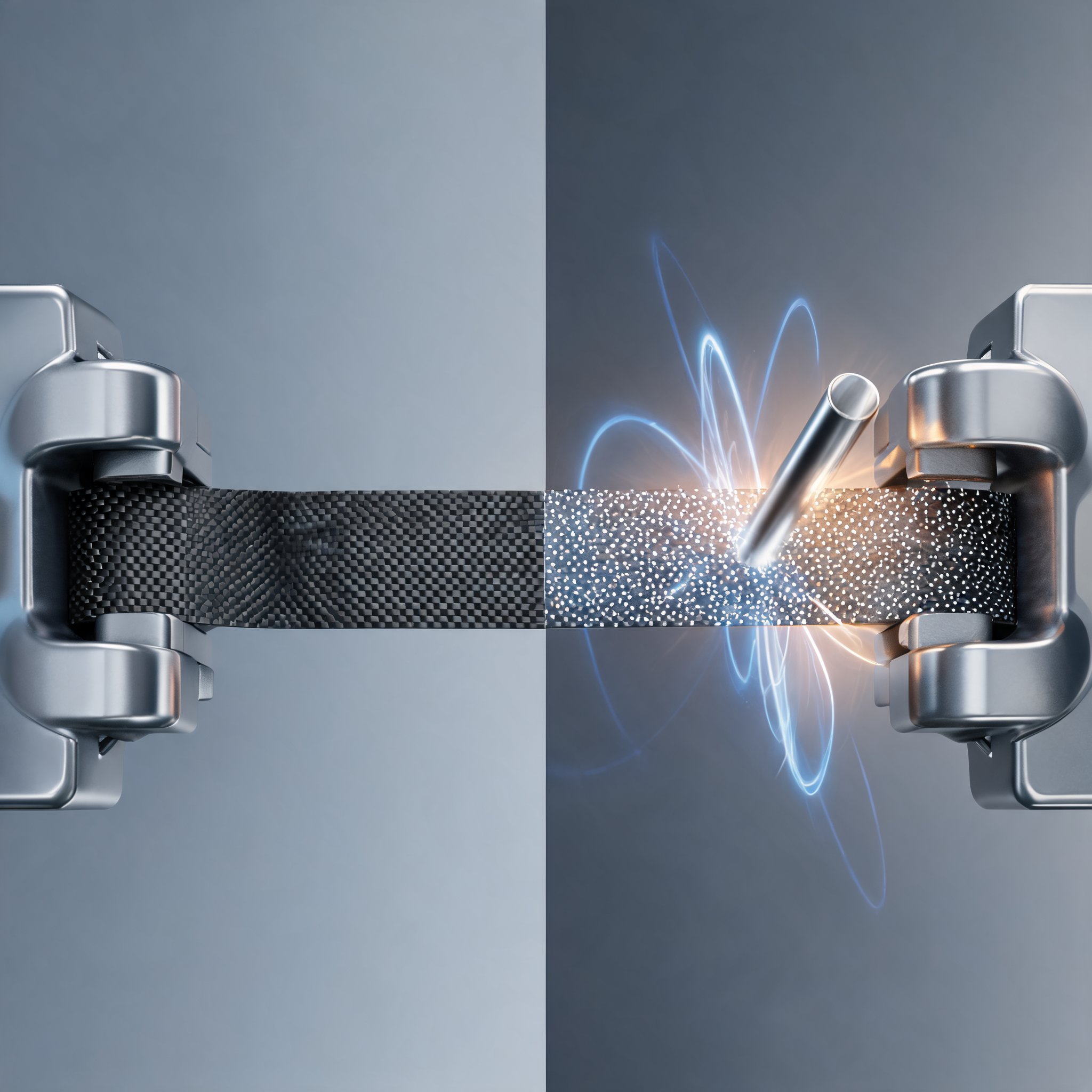
High strain rate testing can give engineers the material data needed to make crash and impact simulations more representative of real loading, according to Andrea Incardona, application engineer and product specialist at Instron, the high strain rate testing machine manufacturer. In a technical article published by the company, Incardona argues that the usefulness of a simulation depends on how accurately the model represents the material itself, not simply on how much test data is available.
Many materials change their mechanical response as loading speed rises. A material characterised under quasi-static conditions may therefore behave differently when subjected to a rapid impact or crash event, a gap that conventional strength and stiffness values do not capture.
A 2025 study puts numbers on the gap
Incardona cites a 2025 study published in the SAE International Journal of Materials and Manufacturing, titled “Influence of Strain Rate Effect on Mechanical and Crashworthiness Properties of CFRP Composite Structures”. As reported in the article, incorporating strain-rate-dependent material properties into crash simulations reduced the discrepancy between simulated and experimental results: the discrepancy in peak acceleration fell by 6.5 per cent, while mean acceleration and displacement discrepancies fell by 5.9 per cent and 6.3 per cent respectively.
Those figures are attributed to the cited study; the article does not describe the test matrix or specimen set behind them.
From quasi-static to roughly 1,000/s
Depending on the specimen, Incardona writes, materials can be characterised from quasi-static conditions up to strain rates approaching 1,000/s, with the achievable range set by the material, the specimen geometry and the test method. Individual tests may last only 3 to 10 milliseconds, which places heavy demands on data acquisition over a very short window.
The argument for doing so is comparative: if strength, stiffness, deformation mechanisms or failure behaviour shift as strain rate increases, a model built solely on conventional data may be unable to represent what happens in a rapid event.
Material selection and weight trade-offs
Two materials that look comparable in conventional testing may diverge under high strain rate conditions. Characterising that dynamic behaviour, the article states, lets engineers consider how each candidate deforms, absorbs energy and ultimately fails under loading conditions relevant to the application. Incardona says this matters most where performance must be balanced against weight, giving examples in automotive crash structures and aerospace components, where dynamic material behaviour can inform both material selection and component design.
Feeding data back into development
The article frames testing as part of a development loop rather than a final check: material behaviour is measured, incorporated into simulation, used to compare design options and then validated through physical testing. Instron says its high strain rate testing systems support data acquisition at up to 200 kHz, while digital image correlation can provide additional information about strain development across the specimen, with analysis tools supporting data processing and theoretical modelling.
The figures on strain-rate range, test duration and 200 kHz acquisition describe Instron’s own equipment and recommended practice rather than independently verified performance; the simulation improvements are those reported by the cited SAE study.