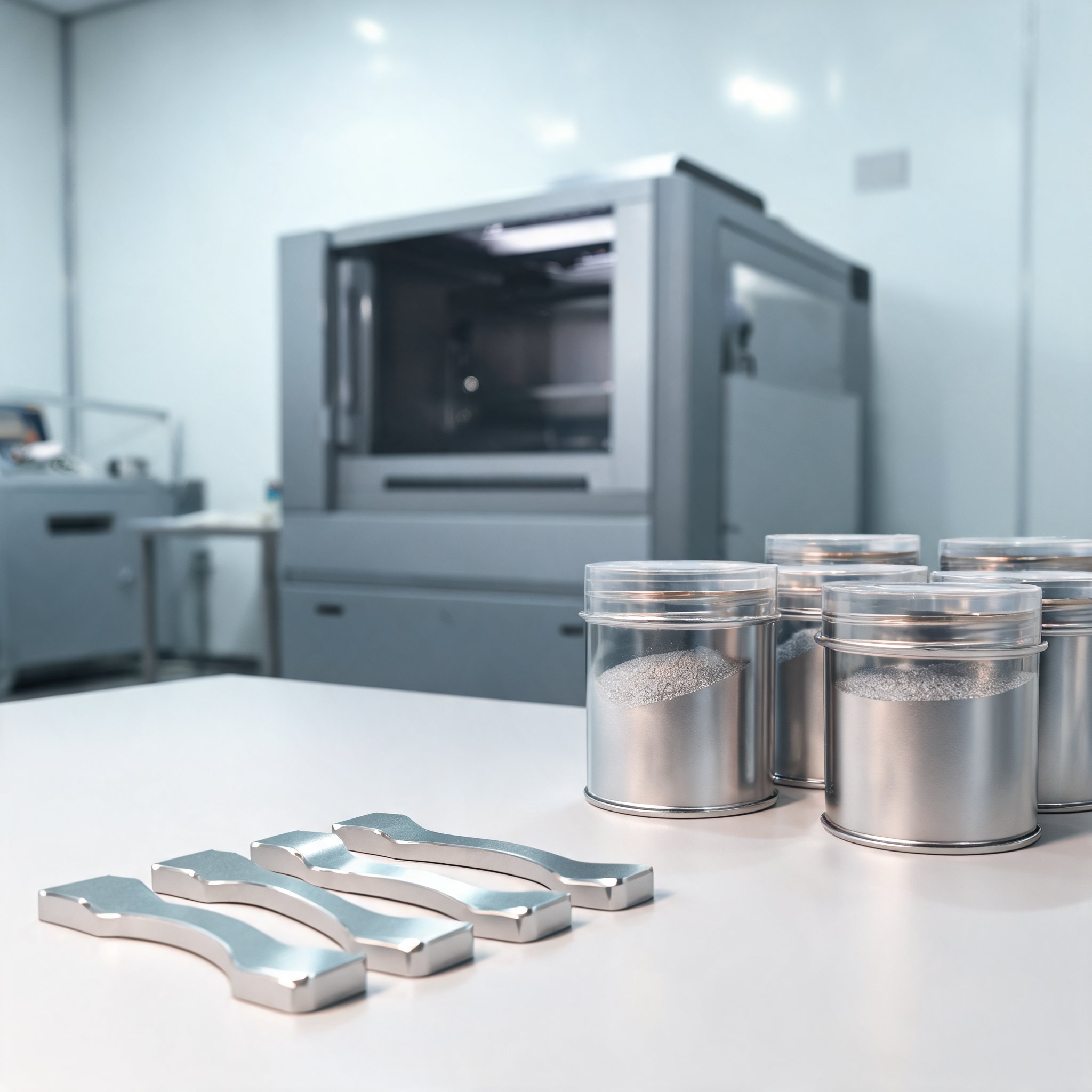
Eplus3D, Rosswag Engineering and qualloy have launched Eplus3D select, a validated metal powder range intended for Eplus3D metal additive manufacturing systems and established process parameters. The initial portfolio covers 316L stainless steel and 17-4PH, both tested and validated on Eplus3D equipment.
The powders have been available through qualloy since November 9. They are stocked in Germany, with delivery expected within two to five business days. Customers already using Eplus3D process parameters for the two alloys can move directly to the corresponding Eplus3D select materials. The companies say this is designed to reduce the additional material qualification work normally needed when a new powder is introduced.
Partnership connects powder, printing and testing
The launch is the first commercial outcome of a strategic partnership the three companies announced in April 2026. Eplus3D contributes its industrial metal powder bed fusion technology and established process parameters. Rosswag Engineering provides material qualification and testing expertise, while metal powder supplier qualloy handles material supply and distribution.
Under the arrangement, the companies aim to qualify materials jointly and develop validated material-process combinations for industrial additive manufacturing. For Eplus3D select, validation builds are produced at Eplus3D Germany using powder supplied by qualloy. Tensile specimens from those builds are then tested by Rosswag Engineering, linking powder supply, additive manufacturing and mechanical testing within one qualification process.
Mechanical testing in two orientations
Mechanical testing was carried out in both XY and Z build orientations. For 316L, the reported ultimate tensile strength was 664 ± 15 MPa in XY and 585 ± 15 MPa in Z. The 17-4PH samples recorded ultimate tensile strengths of 957 ± 10 MPa and 980 ± 10 MPa, respectively. The announcement states that the complete results also cover Young’s modulus, 0.2% yield strength and elongation.
Alongside material performance, the partnership is addressing powder availability as metal additive manufacturing moves toward higher production volumes. Eplus3D select combines the company’s existing process parameters with materials that have already been evaluated on its systems. By making those powders available through qualloy, the partners aim to let users obtain materials assessed against established process parameters, potentially cutting the additional qualification work associated with a new powder.
More powders planned as applications expand
Additional validated powders are planned for the Eplus3D select portfolio, which is expected to expand the material options available to Eplus3D users over time. A sample validation build was displayed at Formnext 2026, with booth references for Eplus3D (12.0 – E101) and qualloy (11.0 – C51); the companies demonstrated how the Eplus3D select qualification process is carried out.
Eplus3D has also pointed to industrial applications beyond the powder launch. Earlier this year, the company worked with Hankook Precision Works to scale production of tire mold sipes on its EP-M300 system. The deployment involved part-specific testing and process parameter optimization, with approximately 100,000 components manufactured under stable production conditions. The project illustrates how established processing parameters can support repeatable manufacturing.
In aerospace development work, Eplus3D supported UCL Rocket in August in manufacturing a CuCrZr combustion chamber for a 7 kN cryogenic rocket engine. The chamber remained intact during hot-fire testing, but machining debris obstructed part of its cooling system and required modified test conditions. The examples add context to the launch and show the company’s broader work in industrial metal additive manufacturing.