Researchers in China have identified why screen printing can degrade copper-plated silicon heterojunction (HJT) solar cells and have proposed a screen-design change to limit the damage. The work focuses on photoresist printing, a step that differs from conventional silver-paste printing and can affect the sensitive passivating contacts that underpin HJT performance.
Screen printing is widely used for solar-cell metallization, but mechanical pressure and thermal treatment can damage passivating structures, raising recombination losses and lowering conversion efficiency. The issue matters for copper-plated HJT cells, which are seen as a route to lower metallization costs and reduced silver use.
Why photoresist printing is different
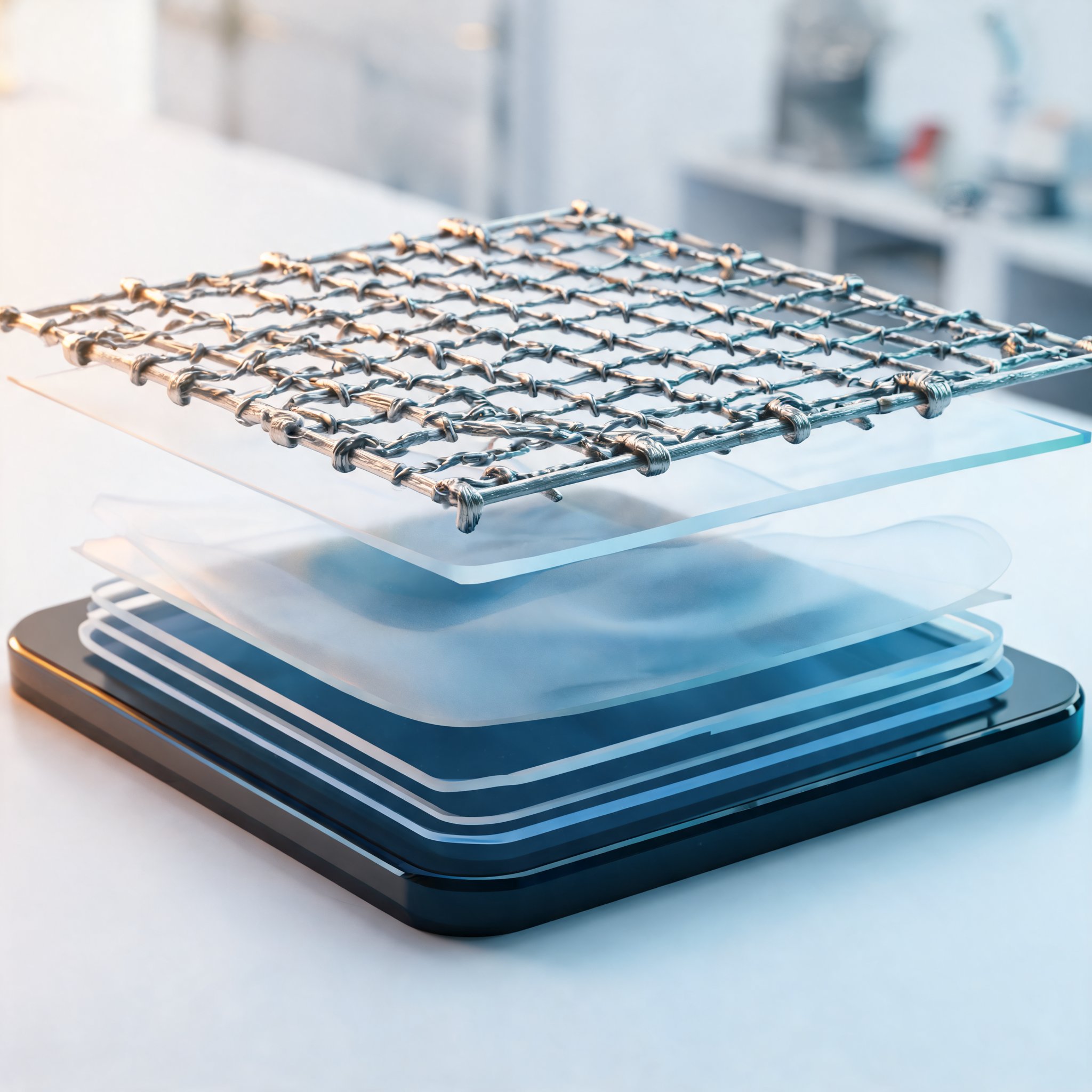
Lang Zhou, the corresponding author, said the photoresist process is fundamentally different from silver-paste printing. In silver-paste screens, openings cover only 2–5% of the area and an emulsion layer keeps the mesh from touching the wafer. Full-area photoresist coating typically uses a screen without emulsion coverage to ensure uniform resist deposition, so the mesh comes into direct and extensive contact with the wafer on every printing cycle.
Earlier production data cited by the researchers showed conversion efficiency falling from 26.2% to 25.7% over 15,000 consecutive printing cycles. Open-circuit voltage and fill factor accounted for most of the loss, while short-circuit current density and electrical resistance remained largely unchanged. Minority-carrier lifetime degradation rose from 0.61% with a new screen to 11.0% after 15,000 cycles.
Wear at the mesh knuckles
Using three-dimensional confocal microscopy, the team traced the decline mainly to progressive wear of the screen-mesh knuckles. As these knuckles flatten, their contact area with the wafer grows, increasing mechanical stress on the passivation layers beneath. Scanning electron microscopy showed no visible surface scratches, but photoluminescence measurements indicated higher recombination losses, pointing to damage at the amorphous silicon/crystalline silicon interface.
An emulsion buffer with a trade-off
To prevent direct contact, the researchers added an emulsion buffer layer to the screen. They tested six patterns with emulsion coverage ratios from 2.9% to 16.6%. Higher coverage protected the wafer but disrupted ink distribution, creating a trade-off between mechanical protection and photoresist coating uniformity.
A 4.7% coverage ratio gave the best balance. It limited minority-carrier lifetime degradation to 0.41% after 10,000 printing cycles while maintaining relatively good coating uniformity. The researchers attributed the improvement to the emulsion layer keeping the mesh away from the wafer and reducing cumulative mechanical damage to the passivation layers.
Zhou said the results show that a relatively simple modification to screen design can substantially mitigate printing-induced degradation, offering a practical way to improve manufacturing reliability for copper-plated HJT cells. The findings were published in Solar Energy in a paper titled “Screen-printing photoresist induced efficiency degradation and mitigation in Cu-plated SHJ solar cells.”
Copper metallization gains attention
The study adds to broader interest in replacing silver contacts with copper in HJT cells. In April 2026, researchers at China’s Nankai University reported a silver-free HJT cell with 25.2% efficiency, using plasma-induced interface engineering and copper electroplating. The approach addressed adhesion, contact resistance and stability at the ITO interface.
Separately, scientists at Germany’s Forschungszentrum Jülich achieved 23.08% efficiency in a fully copper-metallized HJT cell. The silver-free device had a relatively small efficiency penalty compared with its silver-metallized counterpart, while cells combining silver-copper paste on the front and silver contacts on the rear reached 23.95%. Those results underline copper’s potential to reduce silver consumption, though further work on processing and electrical performance is still needed.