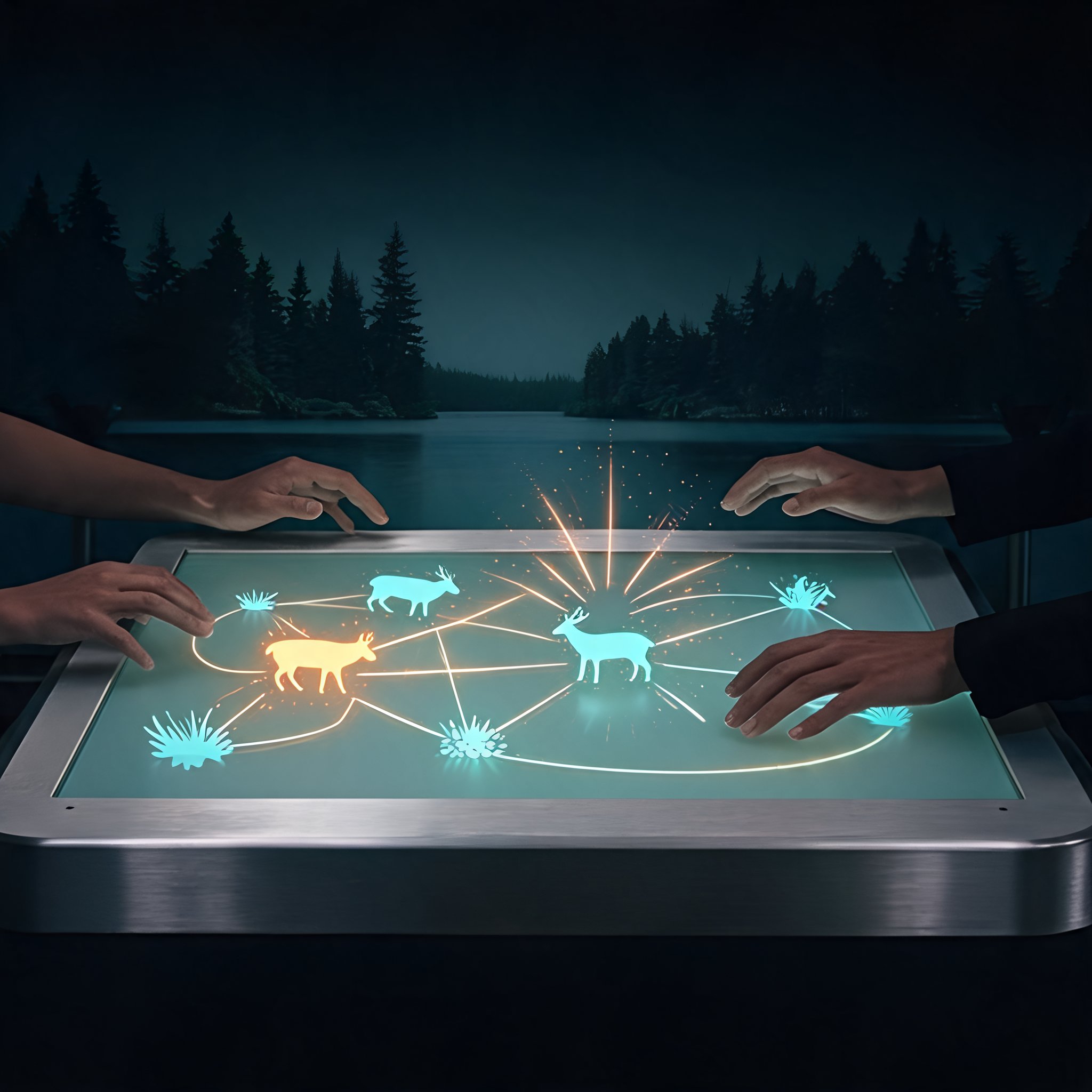
EcoWeb, an interactive experience developed by Swedish studio Lutra Interactive AB, lets visitors build and reshape ecosystems on screen and watch the consequences spread. Add or remove a species and the effects travel through a food web: pulling out a predator can change herbivores and the plants they graze, while losing one species can produce unexpected outcomes for others elsewhere in the network.
The project rests on a simple argument. Biodiversity is more than a count of species in a place; it is also the web of interactions connecting them. Those connections, and particularly the indirect effects that appear when an ecosystem changes, are difficult to convey through conventional exhibits, diagrams or lists of threatened species.
Built on published ecological data
Rather than simplified or invented ecosystems, EcoWeb runs on empirical food-web data drawn from published ecological research, systematic literature reviews and species occurrence records. Its model incorporates both bottom-up and top-down effects, so a change can propagate through the network instead of stopping at the species directly connected to it.
A staged route into complexity
Visitors meet that complexity in steps. They begin by assembling three-species food chains and testing what happens when a species is added or removed. They then work with larger food webs and with different types and strengths of ecological interaction, before reaching complete networks of more than 100 species and over 1,000 interactions.
Individual species can be selected to reveal their connections, and threatened species can be explored directly. In the Swedish forest ecosystem, users can move between recently cleared ground and old-growth forest to see how both biodiversity and the shape of the network change.
Four ecosystems, one framework
EcoWeb currently covers four contrasting settings: the Serengeti savanna, the Swedish boreal forest, an agricultural landscape and Lake Bolmen, one of Sweden's largest lakes. The same underlying approach is applied in each case while retaining locally relevant species, data and environmental pressures.
Where it is running
Designed in collaboration with scientists and educators, the project has moved beyond the prototype stage into real-world use. It has been deployed as a touchscreen experience at Universeum in Gothenburg, Curiosum in Umeå and Visualization Center C in Norrköping, and is also accessible on the web for WWF Sweden.
What hosts have observed
Observations from these installations describe visitors spending time exploring species and their connections. Work with school groups, meanwhile, has generated discussion and reasoning about extinction, indirect effects and trophic cascades. These are accounts of use rather than measured learning outcomes.
Framed around biodiversity loss
Lutra Interactive positions EcoWeb against a defining sustainability challenge: the loss of biodiversity. Protecting it, the studio argues, requires more than knowing that species are disappearing; it requires understanding why particular species matter and how ecosystems depend on the relationships between them. Instead of telling visitors that biodiversity is important, the experience is built to let them experiment with ecosystems and see the reasons for themselves.