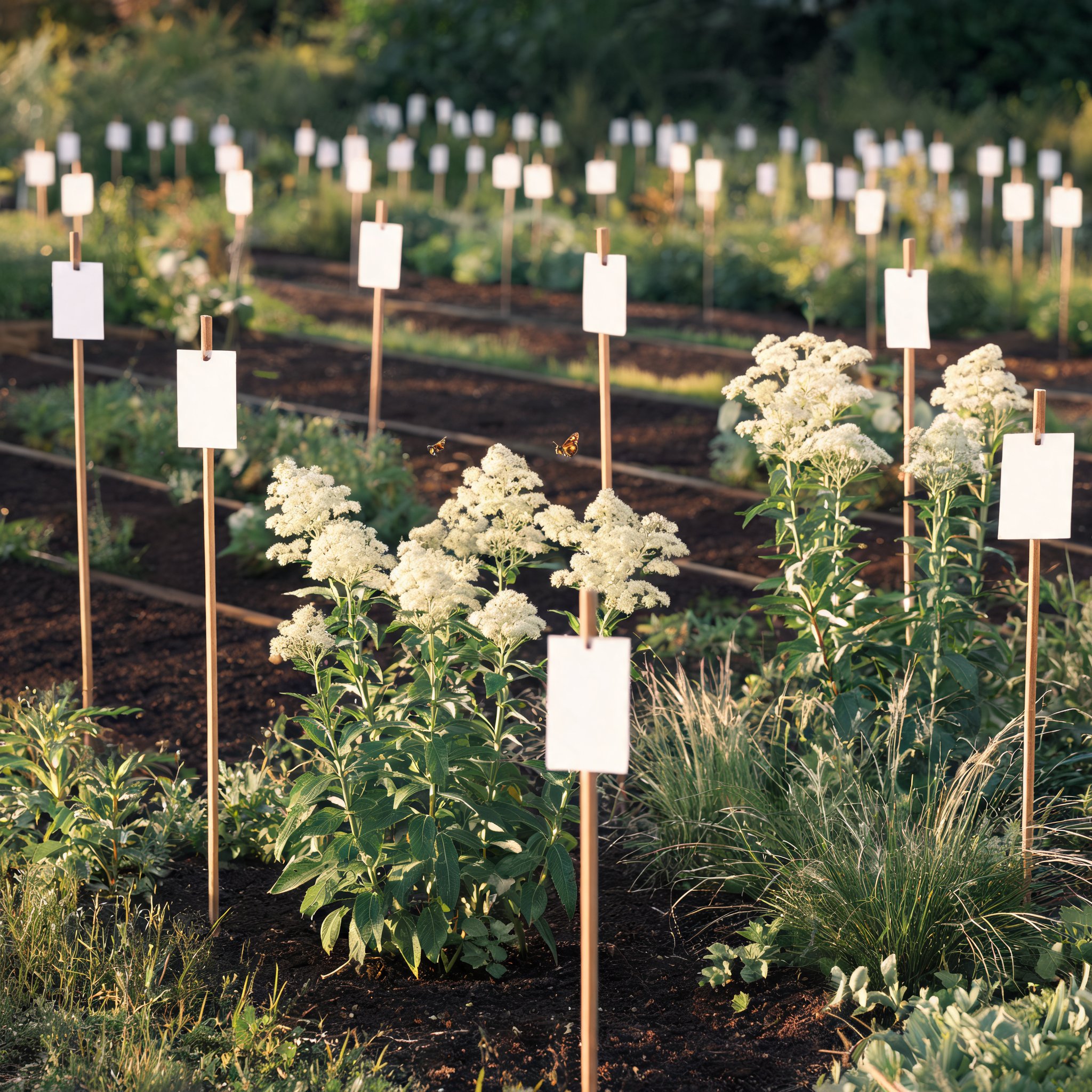
Chicago Botanic Garden’s perennial breeding program is using its nonprofit status to prioritize native plants, niche genera and ecological function over the commercial market’s emphasis on compact, uniform plants, according to Justin Lombardoni, the garden’s ornamental plant breeder. Speaking at the Perennial Plant Association’s National Symposium in East Lansing, Mich., this past July, Lombardoni said his goal was to explain how the program differs from for-profit industry counterparts. To his knowledge, it is the only breeding program at a botanic garden in the country.
The distinction is not merely institutional. Lombardoni said the program’s breeding beds are used to evaluate selections for both ornamental and ecological traits, and its small size and limited resources shape which plants it works on and which traits it pursues. As part of a nonprofit institution, the program is not seeking to release a set number of cultivars each year or to maximize sales of each one, he said. That lack of pressure, in his view, allows it to breed perennials differently from many commercial programs.
Native plants, regional definitions
Lombardoni said the program prioritizes natives, though not exclusively. He acknowledged that people apply different standards when deciding whether a species is native, such as whether it grows in their county, state or region. He prefers the regional standard because plants do not recognize artificial borders between counties or states, particularly when those borders are not marked by physical barriers that keep plants from spreading.
When the program considers an exotic genus for breeding, it looks at two seed-related factors that can contribute to invasive potential. The first is fecundity, or how much seed a plant produces. The second is dispersal, or how readily those seeds spread, whether a few feet or much farther. In some cases, vegetative spread also matters because a species may expand through rhizomes, stolons, suckers or other non-seed means. Lombardoni cited kudzu (Pueraria montana) as an extreme reminder of what can happen when a plant’s ability to spread is underestimated.
Niche genera over mainstream saturation
Native or not, the program largely focuses on niche genera. Lombardoni said its small size and limited resources mean it cannot compete head-to-head with larger commercial breeding programs. Even if it could, he added, many mainstream genera are already saturated with dozens, if not hundreds, of cultivars. He questioned whether the market needs another Echinacea or Hosta when comparatively esoteric genera still have untapped potential.
Traits the program avoids
The traits the program targets vary greatly by genus, Lombardoni said, so it may be easier to describe what it does not pursue. The most prominent example is highly compact cultivars. Such plants have proliferated in industry breeding over the past decade or two because they look good in pots and can be shipped more efficiently. Lombardoni said he would not be against releasing a compact cultivar if a promising selection arose, but it is not something he actively seeks.
He clarified that “compact” in this context means about 30 inches or shorter in height. A 4-foot-tall cultivar bred from a species that is normally 5 or 6 feet tall would not qualify as very compact in his view. He drew a distinction between reining in the size of an unruly species and releasing a cultivar that is half, or less, the height of the species from which it was bred.
The program also avoids sterility, which in ornamental horticulture can sometimes take the form of double flowers. In those cases, additional petals may replace the pistils and/or stamens, potentially reducing available pollen or making other floral resources less accessible to pollinators. More broadly, Lombardoni said the program does not seek to breed cultivars with traits that hinder their ecological function. Pollinator support is an important consideration for many home gardeners, he noted.
To better understand that function, Lombardoni hopes to collaborate with the Garden’s Science Department, which is partnered with Northwestern University, to study pollinator visitation to the program’s breeding selections and compare their performance with straight species. The work could help show how the abundance and diversity of pollinator visitation compare between the two groups. The collaboration is a hoped-for next step, not a completed study.
An example in ‘Summer Snow’
Lombardoni pointed to Eutrochium maculatum ‘Summer Snow’, which the program released about 10 years ago, as a cultivar that encapsulates these points. It was bred from germplasm collected roughly 90 miles from the Garden. Although that germplasm came from three counties away, he still considers ‘Summer Snow’ a native selection because its species is also native to the Garden’s county. At 5 feet tall, it is not significantly shorter than the straight species, and its highly upright stems bear white flowers that support pollinators from mid- to late summer.
The commercial tension
Aesthetics are understandably a major consideration when breeding perennials for the commercial market, especially how a plant looks in a pot. Lombardoni said ecological function may not always receive the same emphasis. Because the Chicago Botanic Garden is a nonprofit, its breeding program is not chasing a quota of cultivar releases or maximizing sales of each introduction. That freedom, he argued, creates room for a different set of priorities.
The approach also has boundaries. Lombardoni described a program shaped by limited resources and focused on niche genera rather than broad competition with commercial breeders. Its native-plant priority is stated as a preference, not an absolute rule, and its pollinator research is still at the collaboration stage. Even so, he hopes the model points to a future in which gardens are not made up entirely of perennials 2 feet or shorter.