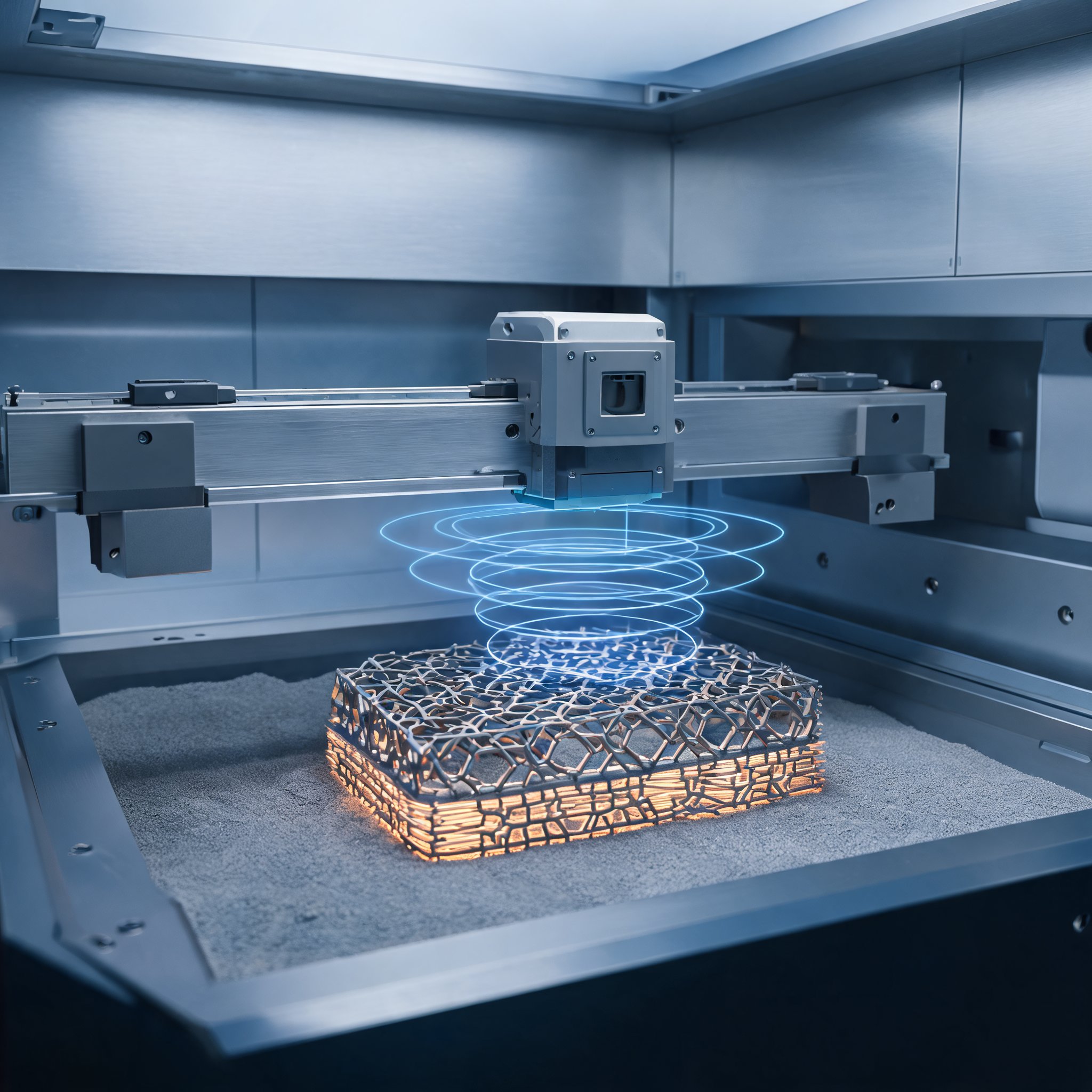
AMiquam, a Swiss technology company, reports improved sensitivity in its in-situ eddy current inspection technology for metal additive manufacturing, detecting defects as small as 0.1 mm in thin-walled components produced by laser powder bed fusion (LPBF). The results were set out in a technical publication released ahead of Formnext 2026.
The approach uses an eddy current sensor built into the recoater assembly of an LPBF machine. As the recoater travels across the build platform, the sensor scans each newly deposited layer and records electromagnetic signals that can indicate internal defects. Inspection data is mapped onto the component geometry, so that detected anomalies can be located and reported automatically.
Thin-wall trials reach 0.1 mm
The headline result concerns thin-walled structures of the kind used in additively manufactured heat exchangers. On a 316L stainless steel test specimen with a 0.7 mm wall, AMiquam detected five artificially introduced holes with diameters between 0.1 mm and 0.5 mm. Both through-holes and blind holes produced distinct peaks in the eddy current signal, and even the smallest 0.1 mm indication could be separated from background signal variation. Measurements were collected over roughly 127 layers, with each hole generating a corresponding peak as the build progressed.
According to the company, the results indicate potential for inspecting complex structures such as triply periodic minimal surface (TPMS) heat exchangers, where internal channels and thin walls make conventional post-process inspection difficult.
A certificate for each build
AMiquam also describes a concept for an inspection certificate covering material, layer coverage, detection limits and detected indications, giving a structured record of inspection data generated during manufacture. The certificate shown in the publication is an illustrative example rather than an actual component certification.
Aeroengine blade application
A second application looks at LPBF-manufactured aeroengine blades, where a conformal laser scanning strategy is used in the surface skin while the bulk is built with a conventional chessboard strategy. The differing microstructures influence the eddy current signals recorded during inspection. AMiquam reports detection capability of about 0.2 mm in the conformal skin, compared with a threshold of roughly 0.5 mm in the bulk, where microstructural variation adds signal fluctuation that makes smaller indications harder to resolve.
The company notes that sensitivity depends on material characteristics, laser scanning strategy and component geometry, and suggests that optimising laser strategies could improve detection in bulk regions.
Location data and remaining limits
Beyond detection, the system is intended to place defects precisely within a part. Signals from each recoating pass are mapped to the geometry, and software flags indications above predefined thresholds and assigns positions in X, Y and build-layer coordinates. That gives manufacturers spatial information on where defects occur, supporting later investigation of their origin, and allows quality issues to be spotted during the build rather than after completion.
For aerospace, energy and medical production, where qualification and traceability matter, inspection evidence generated in-process could reduce reliance on time-consuming post-build testing. AMiquam cautions, however, that detection thresholds remain dependent on geometry, material and process parameters, and that the reported figures should be read as application-specific rather than universal performance limits.