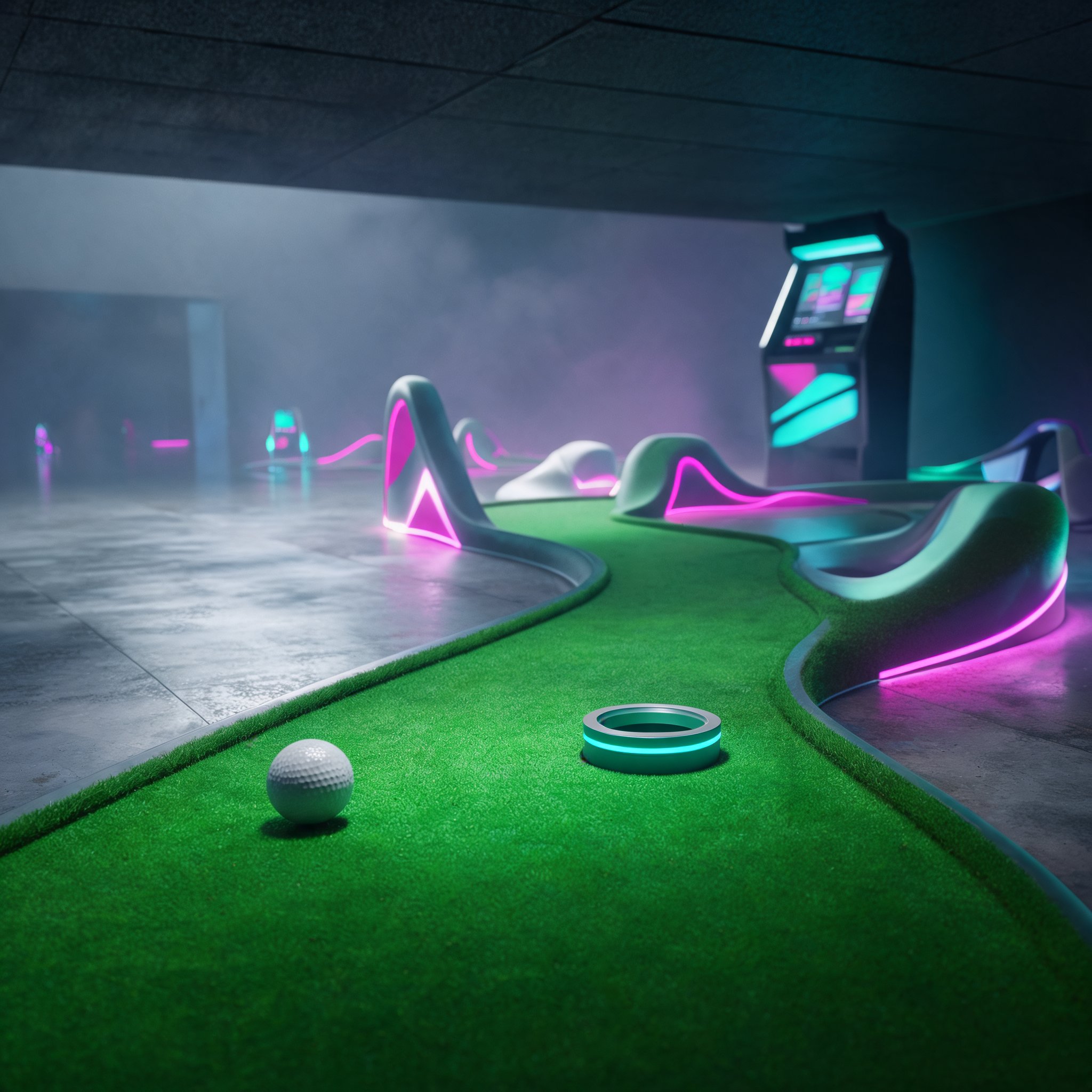
Holovis is repositioning its 360Golf brand from a technology-enabled putting game into a connected gaming platform aimed at the competitive socialising market. The offer combines automated scoring, a suite of gamified features and an AI analytics engine that gives operators data on how their courses and guests perform.
The starting point is the format's familiarity. Stuart Edgington, global director of business development, said mini golf is already one of the world's most accessible leisure activities, so the company builds technology on top of an appeal that needs little explanation rather than reinventing it. Guests of all ages register at a kiosk, collect an assigned smart ball and begin playing, which the team says limits the staff time needed to run the attraction.
Automated scoring and gamified layers
The core of the platform is automated scoring. Smart balls, tees and cups work with Holovis' HoloTrac scoring system, removing paper scorecards and acting as a referee when play gets competitive. On top of that sit features such as SuperShots, which offer alternative ways to score, and Triumphs, which present awards and unlock new challenges, alongside bonuses, on-course games, player accounts, achievements, leaderboards and video celebrations.
Matt Dobbs, business development director, said the combination gives players more reason to compete, celebrate and compare scores after a round, and therefore more reason to return. The features also help build a profile of who is playing, which feeds into the analytics layer.
A data layer for operators
The DeepSmarts AI engine supplies operators with information on uptime, how players interact with the course, seasonality and where operations might be adjusted. Edgington said this can be offered as an additional service, and Maaz Ussen, project manager, added that the system also supports remote diagnostics, allowing engineers to review an incident and identify the cause without an immediate site visit.
The platform is designed for throughput of up to 80 people per hour per course. Dobbs argued that the self-service kiosk flow frees operational teams to look after guests, food and drink, which he linked directly to secondary spend and F&B revenue.
Design options, from retrofit to custom build
Installation formats vary by venue and turnaround:
- Tech-only retrofits that add the scoring and gaming layer to existing mini golf attractions, scheduled at roughly six to eight weeks.
- Catalogue holes drawn from a tried-and-tested range, installable and ready to play in eight to 12 weeks.
- Fully bespoke courses, which can take upwards of six months, such as the IP-led Top 9 course at Netflix House with themes including One Piece, Squid Game and Floor is Lava.
Other projects require engineering for physical conditions. Tee Time, delivered in four installations for Norwegian Cruise Line, uses marine-grade, IP-rated components including rugged cups and tees and specialist screens so the experience works at sea.
Scale, inclusion and new play formats
Multi-site operators such as Saudi Entertainment Ventures (SEVEN) can use the underlying technology to keep consistency across locations while varying theming, layout or branding. Smaller venues can choose simpler, more cost-effective designs and still keep the scoring and replayability, which the team sees as a route for operators building toward a chain.
At Butlin's Bognor Regis resort, the PLAYXPERIENCE indoor activity centre opened in 2024 as a £15m project with three nine-hole 360Golf courses: a neon glow layout, a Las Vegas-themed course and a wheelchair-accessible, music-themed course. Dobbs said busy weeks bring about 5,000 players and around £40,000 in weekly revenue. Ussen said the project sharpened the team's approach to inclusive design, from left- and right-handed play and putter sizing to lowering the top cap so wheelchair users can get close to or onto a hole.
Other recent work includes a 12-hole sports-themed package at Super Social in Leopardstown, Ireland, and a project for Lucky Duck in Norway where each hole offers two play routes.
Beyond mini golf
Holovis is also working on an integration with Roxy Leisure to add stroke-counting technology to its crazy pool tables, and Ussen said the ambition is to apply the technology to other sports. Edgington expects competitive socialising to reach peak saturation eventually, which he said makes adjacent markets worth investigating.
Starting a project
Dobbs said conversations with interested operators should begin with the venue's constraints, whether a catalogue or custom course is appropriate, and the target audience, such as young adults on weekend evenings or a mix of children and grandparents. He described the result as a complete turnkey offer rather than the sale of a course alone, covering commercial modelling and ongoing support.
360Golf will exhibit at the Land Leisure & Tourism Show at NEC Birmingham on 4-5 November at booth LLT360 in the Holiday Village, and at IAAPA Expo in Orlando on 16-20 November at the Holovis booth, #S448. Playable demonstrations can also be booked at the 360Golf Orlando office, a short distance from the convention centre.